
In my experience, I haven’t noticed a difference between posting manually on Facebook and scheduling posts ahead of time.
And that’s coming from my experience as a publisher who earns several thousand bucks from Facebook Content Monetization and website traffic.
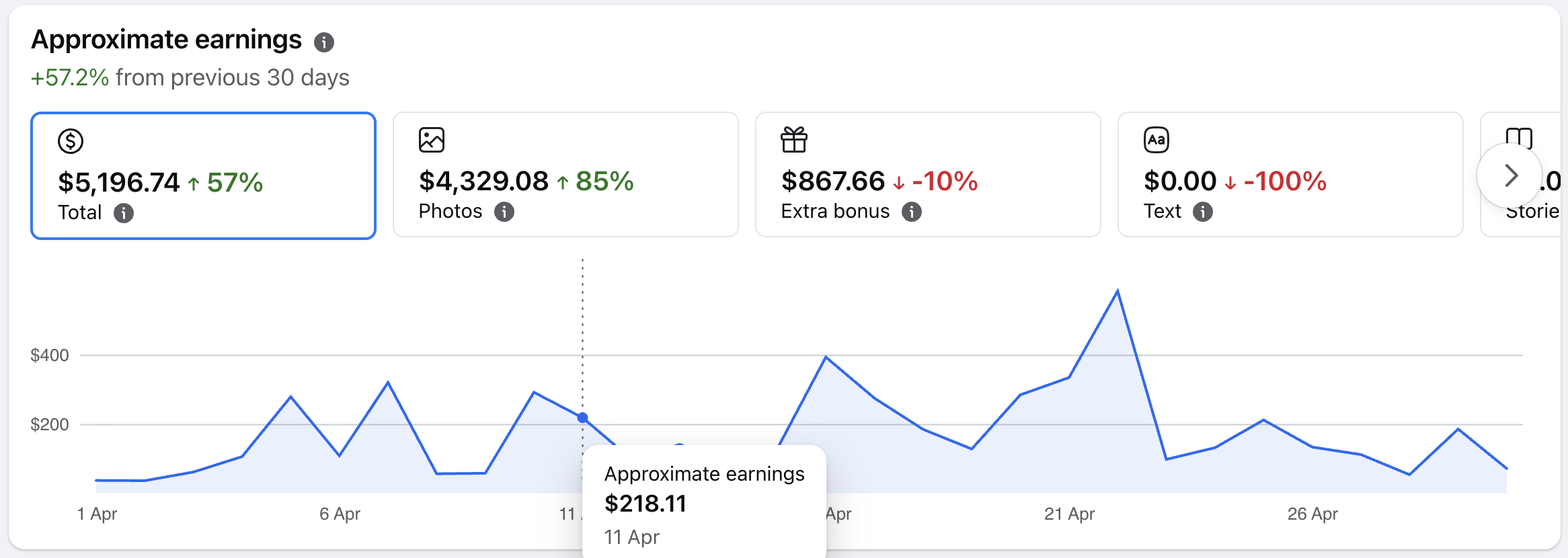
One month of FB CM earnings
I’m not sharing the screenshot above to brag about how much I earn from Facebook. I’m sharing it simply to give some context around how much experience I have posting and testing content on Facebook.
That said, this is still based on my own experience. It isn’t a controlled experiment, and I wouldn’t expect anyone to completely change their workflow just because I say scheduling is fine.
The concern is understandable. You schedule a post, it disappoints, and you wonder whether Facebook would have shown it to more people if you’d clicked the Publish button yourself.
My view is that a disappointing post isn’t enough reason to blame the scheduler. The published Facebook research gives us reasons to question a blanket scheduling penalty, even if it doesn’t promise identical results for every post.
The Short Answer
You don’t need to assume Facebook suppresses a post simply because you scheduled it. Published Facebook comparisons have not shown a consistent blanket disadvantage for third-party publishing.
But no scheduler can guarantee the same views as a manually published post. Most of the research compares publishing tools, not a perfectly matched scheduled post and an immediate post. Some results also favor native publishing for particular formats.
For me, that’s enough reason not to abandon scheduling out of fear. It isn’t a reason to ignore my own results.
First, three terms worth separating:
- Reach is the number of people a post reaches.
- Views or impressions count displays or plays under the definition of the particular report. They aren’t necessarily unique people.
- Engagement means actions such as reactions, comments, shares, or clicks, depending on the study.
People often ask about “views” when they mean “how many people saw my post.” Much of the research below measured reach or engagement. I won’t pretend those numbers are interchangeable.
What Facebook Publishing Tests Found
Agorapulse: scheduled publishing tools weren’t automatically worse
Agorapulse’s Social Media Lab ran a three-week Facebook experiment in 2017 across three Pages. It compared Facebook publishing with Agorapulse, Buffer, and Hootsuite, rotating the publishing routes across time slots and using photos and links.
Its reported conclusion was:
“3rd party apps performed on average 22.61% better on these pages combined.”
That is useful evidence against the idea that using an outside publishing tool inevitably hurts distribution.
I wouldn’t turn it into a promise that a scheduler will increase your reach by 22.61%, though. Agorapulse sells a scheduling product, the test covered only three Pages, and the article doesn’t provide a formal statistical test. One result label is also unclear, which makes its overall percentage difficult to check independently.
My takeaway is much simpler: in that experiment, using a publishing tool was not an automatic disadvantage.
Buffer: Facebook’s own scheduler versus an outside scheduler
A 2015 Buffer comparison is especially relevant because both methods involved scheduling.
Buffer used Facebook’s built-in scheduler for one week and compared the results with a week using Buffer. The reported averages were:
- Facebook’s scheduler: reach of 1,357 and 66 engagements per post.
- Buffer: reach of 1,595 and 70 engagements per post.
Buffer wrote:
“From November 15th-21st we scheduled every post natively through Facebook’s own scheduling tool.”
The outside scheduler did not perform worse in that comparison. But this was one Page across two weeks, not a large experiment with identical content. Buffer itself acknowledged that the study didn’t prove anything concretely.
This distinction matters: the test compared two ways of scheduling. It didn’t show what would happen if those same posts were published immediately instead.
Buffer’s later test found similar overall reach
In a later experiment conducted in 2017 and published in January 2018, Buffer compared third-party publishing with native publishing. Its headline Facebook results were:
- Third-party tools: nine posts, with average reach of 9,071.
- Native publishing: nine posts, with average reach of 8,820.
Again, there wasn’t an overall reach disadvantage for the outside tools in that small comparison.
You’ve probably seen this described as a study of “200+ posts.” That figure covers multiple social networks. The headline Facebook comparison above had nine posts on each side, so I wouldn’t use the bigger number to make the Facebook evidence sound stronger than it is.
The formats weren’t evenly balanced either, and some image and video comparisons favored native publishing. The overall result is reassuring, but it doesn’t mean every format performed equally.
Not every finding favors scheduling tools
Sendible’s 2020 analysis examined more than 5,000 posts from 58 Facebook Pages. It reported 10.3% higher overall engagement for third-party publishing, but its photo and video results went the other way: photo engagement was 32.2% lower, and video engagement was about 20% lower.
Those are engagement results, not proof of a views advantage or a views penalty. It was also an analysis of existing posts, rather than a randomized experiment. Different content, Pages, and publishing habits could affect the comparison.
I think this is worth including because leaving it out would make the answer sound more certain than the evidence allows. Scheduling tools can produce good results without winning every comparison.
Why People Believe Facebook Penalizes Scheduling
The concern has some history behind it.
In December 2011, EdgeRank Checker analyzed 391 Facebook Pages around a reported fix affecting third-party publishing. It reported that the average disadvantage for API-published posts in its impressions measure narrowed from 19% before the fix to 1% afterward.
An API is simply the connection software uses to publish to a platform. You don’t need to understand the technical details to see why a problem with that route could worry Page owners.
Buffer also reported a statement from Facebook developer consultant Matt Trainer in November 2011:
“…we recently made a fix that added more signals to detect good quality posting behavior. This should improve the situation with the distribution of posts coming from third-party apps in the News Feed.”
The original Facebook bug-page statement is no longer available in the retrieved source. That quote survives through contemporary reporting, so I treat it as historical context, not a current Meta policy guarantee.
Still, it helps explain the fear. It wasn’t necessarily invented out of nowhere. The mistake would be treating a problem reported in 2011 as proof that every scheduled Facebook post gets penalized today.
What Adam Mosseri Said About Scheduling
There is a clear, recent executive statement, but it needs the right label.
On March 17, 2026, Instagram head Adam Mosseri published a Reel with this caption:
“One of the most common questions I get is does scheduling a reel hurt your reach? and the answer is categorically no.”
That’s reassuring for Instagram Reels. It is not a Facebook-specific announcement.
I would not rewrite it as “Meta confirms scheduled Facebook posts get the same reach.” His statement doesn’t name Facebook, Meta Business Suite, or every third-party publishing tool. I haven’t found a verified current Facebook-wide executive statement that makes that promise.
The distinction is small in wording but important in meaning. We can use the Instagram statement as context without pretending it answers a different platform’s question.
What I’d Check Before Blaming a Scheduler
Facebook’s engineering explanation describes a personalized ranking process that considers things such as relationships, recency, post type, and predicted interactions. That doesn’t reveal every ranking signal, but it does show why comparing two different posts is complicated.
If a scheduled post performed badly, I’d check:
1. Was the content comparable?
A routine update and a timely story aren’t a fair comparison. I would compare similar topics and formats rather than one scheduled link post against an unusually successful manual video.
2. Did it publish at the intended time?
Check the time zone and the actual publication time. A timing mistake is a practical problem to fix, not evidence that Facebook dislikes scheduled posts.
3. Did the finished post look right?
Open the published post. Check the image, video, link preview, caption, and destination. A post that looks different from what you intended deserves investigation before you blame an algorithmic penalty.
4. Am I comparing the same measurement window?
A post that’s been live for a few hours shouldn’t be judged against one that’s had several days. Give both the same amount of time before comparing results.
5. Is there a repeated pattern?
One weak post tells me very little. If a particular publishing method repeatedly underperforms on comparable posts, that is worth investigating, even if a vendor’s study says its tool performed well.
These are troubleshooting checks, not claims that they explain every low-performing post.
A Simple Way To Check Your Own Page
If the concern keeps bothering you, I’d run a small practical comparison instead of changing your whole workflow overnight.
Keep separate records for:
- Posts published immediately through Facebook.
- Posts scheduled through Meta’s own tools.
- Posts scheduled through an outside tool, if you use one.
Rotate those methods through comparable posting times. Keep photos, links, and videos separate when reviewing the results, and avoid putting all your strongest ideas into one method.
Choose your main metric before starting. If you care about distribution, use the same reach or views metric throughout. If you want website visits, don’t use reactions as a substitute for traffic.
Record the method, topic, format, publication time, any paid promotion, and the result after the same observation window. Look at typical results as well as the average so one unusually successful post doesn’t decide everything.
This won’t magically turn a small Page test into scientific proof. It will give you something more useful than comparing two unrelated posts and guessing why one lost.
I Wouldn’t Give Up Scheduling Out of Fear
I haven’t noticed a difference between manual posting and scheduled posting in my own publishing experience. The research doesn’t give me a convincing reason to assume an automatic scheduling penalty either.
What it does give me is a reason to be careful with sweeping promises. The Facebook tests are mostly old, small, or observational, and some formats performed better through native publishing.
My advice is to choose the workflow that lets you prepare good posts and publish them when you intend to. Check the finished posts, watch your results, and investigate patterns if they appear.
I wouldn’t go back to clicking Publish by hand just to satisfy a rule that the available evidence doesn’t establish.
How I schedule and analyze our Facebook posts
I used to pay for two tools: one to schedule posts and another to see what actually worked. It was expensive, messy, and neither was really built for Facebook pages. So I built my tool that does both, properly, in one place: Insight Hive.