
The idea of driving traffic from Facebook is to build a Facebook page large enough that you can introduce your articles to fans who are willing to read your content.
In reality, it’s not complicated. There are just a few key things to keep in mind.
First, you need a Facebook page that’s big enough and active enough. The followers have to be real people to generate meaningful, high-quality traffic to your website. Fake followers or bots obviously won’t work.
To attract real Facebook users, you can grow the page organically from zero, OR spend some money on Facebook ads to gain genuine followers as a base. Normally, that base can be around 10K followers. Building this initial follower base will make your life much easier than starting everything from scratch.
Second, your fans need to love your content. This is where many people fail. If people don’t enjoy your page or your posts, you can’t expect them to click your links and read your articles.
A good rule of thumb is to respect your audience. Read their comments regularly and try to understand what they enjoy reading and talking about. Treat them like real humans, not just numbers in your GA4 dashboard.
So how do you produce content your followers will love?
It’s both hard and easy at the same time.
The simplest way to learn what fans want is to find competitor pages in your niche, pages that represent what you want your page to become. As beginners, we rarely know which types of posts work best. Learning from pages that have already succeeded makes a lot of sense.
And it really works.
I wrote another article explaining how to find these pages (it’s simple and free).
Once you have some content ideas that seem promising for your audience, it’s time to test them on your follower base (remember the 10K followers we talked about earlier).
Schedule or publish those posts and see how your fans react. Do they love them or ignore them? Either way, you get useful results.
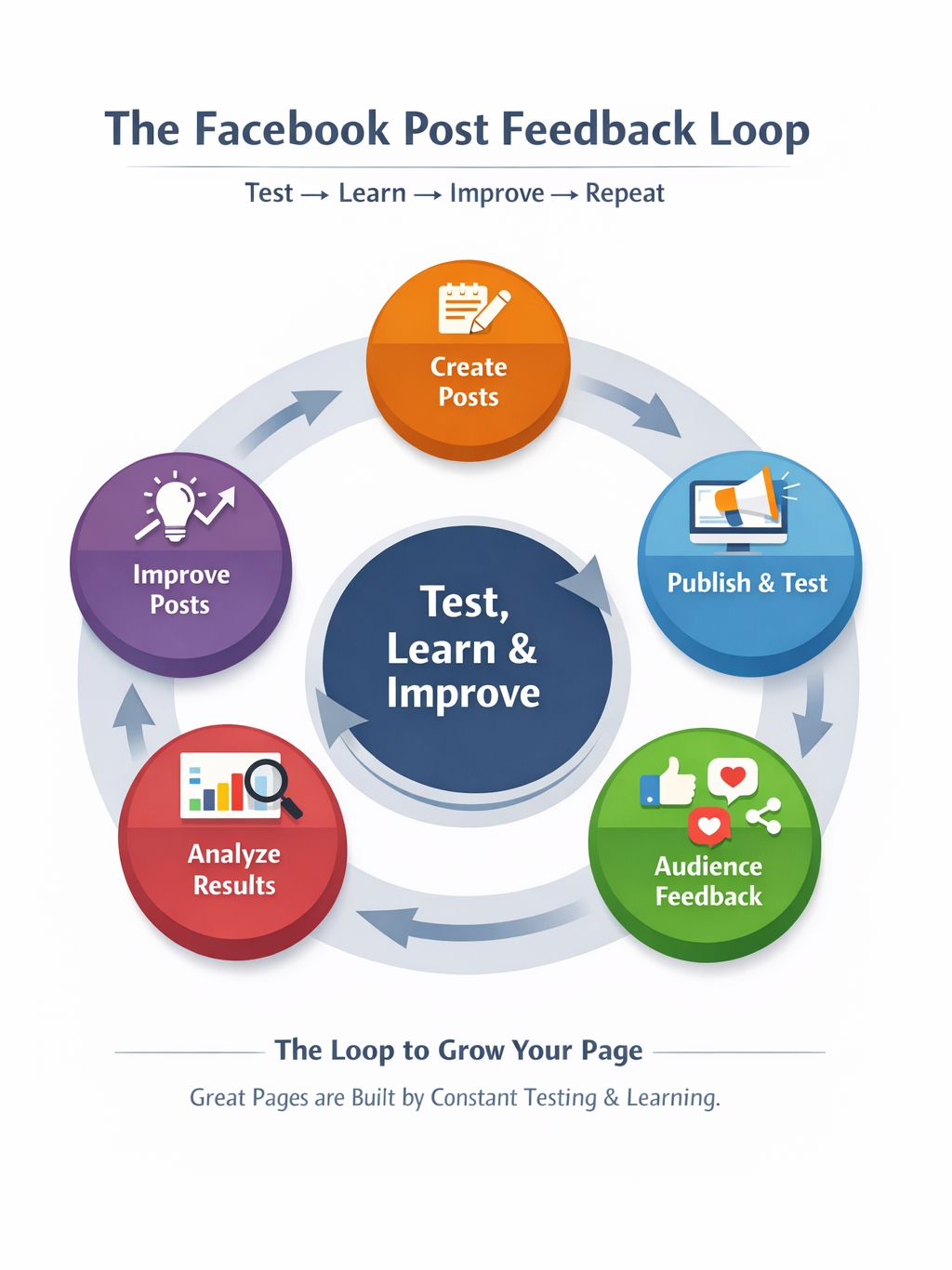
Then create another batch of posts that improves on the previous ones. Test again. Review the results. Repeat the process.
Keep doing this until one or two posts start going (mini) viral.
I asked GPT to generate a feedback loop diagram below that perfectly illustrates this process.
When testing Facebook creatives (posts), try to create the best posts you can. Don’t aim for average. Really try your best.
Over time, you’ll learn what users like (which is valuable feedback) and what they don’t. The mindset here is simple: learn and improve.
Now, once you have a decently engaging Facebook page in your niche, the next step is to drive traffic to your website.
To do that, you need to give people a reason to click your article.
That reason (hook or promise) might be:
- The answer to a question
- A hidden gem revealed in the article
- More interesting facts related to the post
- (many more)
This is where the game becomes harder, but still very doable.
The better your hook or promise, the easier it will be to drive traffic to your article.
Just make sure you deliver on that promise. Otherwise people will stop trusting your posts.
I cannot emphasize this enough:
We are publishers, not spammers.
We deliver value, not bait.
From my experience, creating and growing a page to 20K followers is easy (especially when running ads). Where most people fail is in engaging their followers and giving them a reason to read their articles.
When you’re just starting out, it’s best to do everything yourself first. Avoid outsourcing the work to VAs too early, and definitely avoid producing posts in bulk without knowing whether your fans actually like them.
The fastest way to kill a Facebook page is to keep posting content that nobody cares about.
Don’t do that.
Take your time when creating posts and articles. Learn the process slowly.
Crawl → step → walk → run.
There are no shortcuts.
Example of a Strong Facebook Post With a Clear Promise
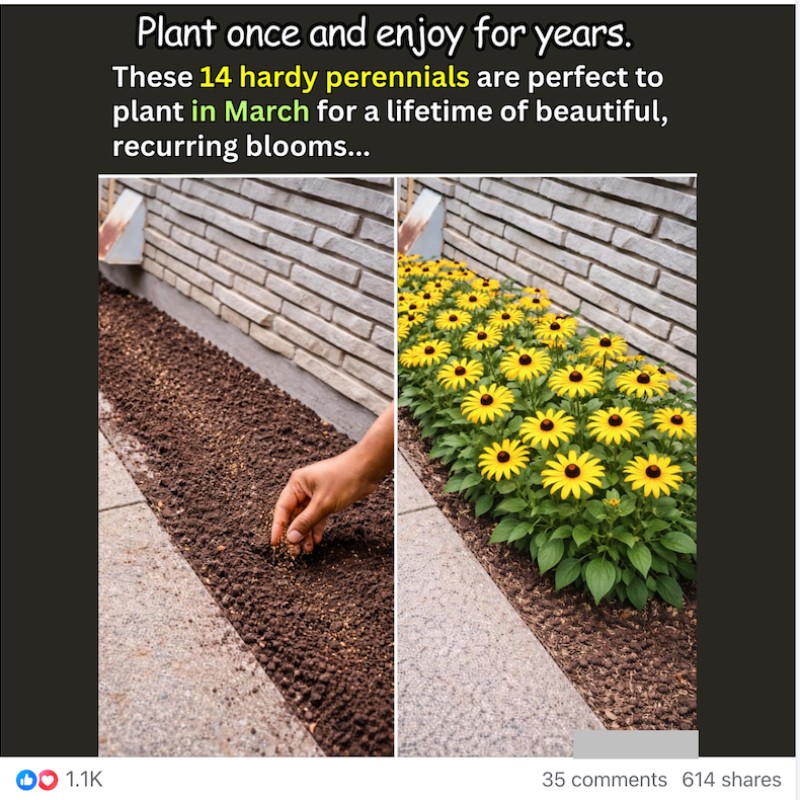
Below is a real Facebook post example with strong engagement (1,000+ likes and 600+ shares).
The article link was placed in the first comment, which clearly generated traffic to their website.
You might ask how much traffic exactly. I don’t know the exact number, but from experience, the stronger the hook, the more traffic the post generates.
Let’s analyze the example.
The promise of the post is to show 14 perennial plants that guarantee “hardy”, “lifetime”, “beautiful”, “recurring blooms”, “plant once”, “enjoy for years”.
The before-and-after images also play a huge role. They clearly show readers what to expect without making them guess. Post images should always be clear and easy to understand so followers can quickly decide whether the content interests them. Don’t confuse readers. And definitely don’t trick them.
Personally, I’m not even passionate about gardening, yet those promises and visuals still make me curious enough to check the article in the comment section.
When readers open the article, it becomes clear that the publisher created a listicle that delivers exactly what the Facebook post promised.
Strong Hook Post With Solid Traffic
To help estimate traffic from Facebook posts, I looked at our page posts analytics in the Insight Hive app and picked a good example.
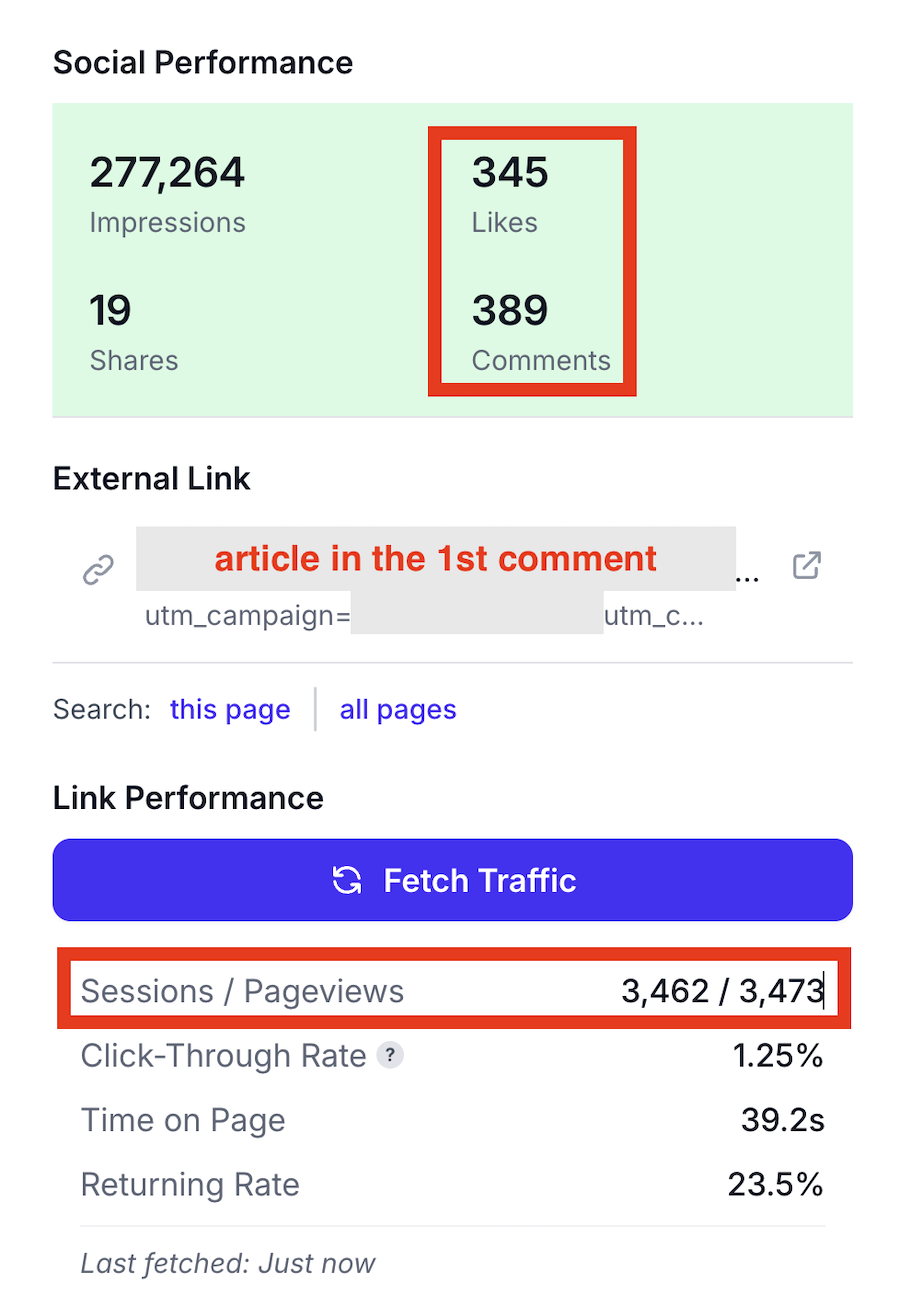
This image post had fewer than 350 likes and around 400 comments, yet it generated 3,000+ sessions to our website. The article was in the first comment.
In this case, the Facebook page belongs to a fandom niche (think Harry Potter, The Lord of the Rings, Marvel).
The hook was simple: The post promised an explanation from a film director about why he killed a promising powerful villain, something that had confused fans for years.
In the article, we delivered exactly that explanation.
As mentioned earlier, traffic volume varies widely depending on the strength of the hook. The stronger the hook, the more traffic you can expect. In this example, the hook is solid I believe.
Weak Hook Post With Low Traffic
Now let’s look at the opposite case.
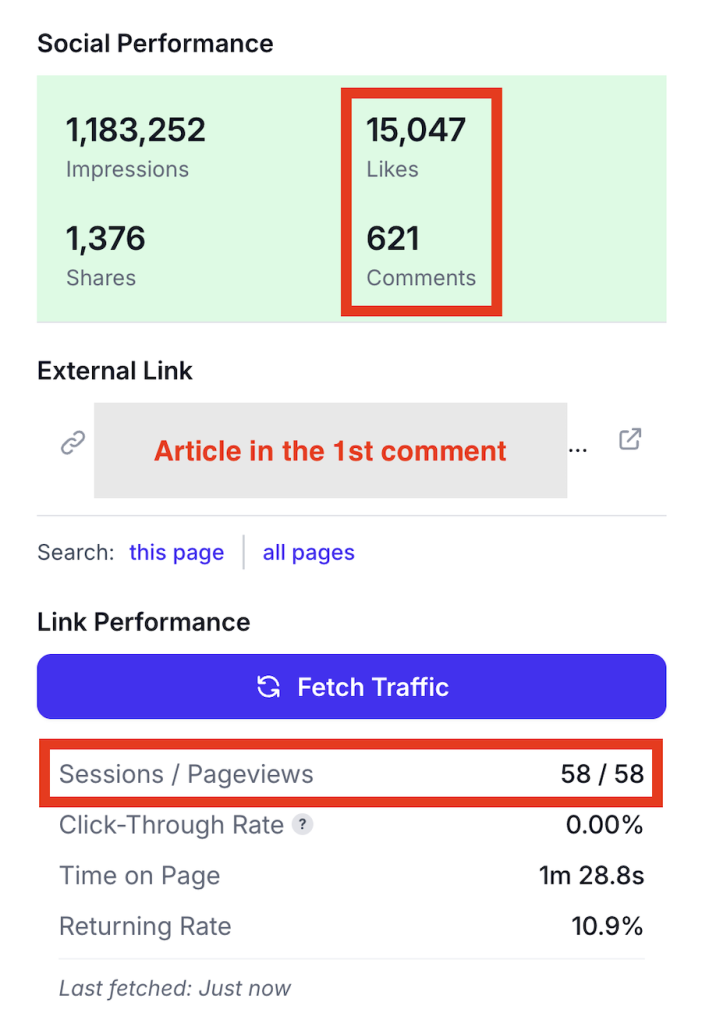
The image post above shows an impressive cosplay personalized with a country theme. Fans loved it and the post received huge engagement numbers (15K+ likes).
But there’s a problem.
The cosplay itself already satisfied the audience. There was almost no reason for them to click our article link which is about similar other cosplays.
As a result, the post only generated 58 sessions.
However, the post was not a waste.
Even posts that generate little traffic can still help your page by entertaining followers and sending positive engagement signals to Facebook’s algorithm.
Those signals may help Facebook push your future posts further.
They also help attract organic followers, who usually engage better than followers acquired through ads.
Notes for Beginners
The testing and learning phase can last anywhere from 1 to 5 months, and it won’t always be easy. Don’t give up too quickly.
Keep testing until you find something that goes viral (with or without links). Then study the pattern and figure out why it worked.
Repeat the wins. Learn from the mistakes.
If you need to take a break, that’s okay too.
Clear your mind, gather new ideas, and come back later.
That’s one of the great things about running a Facebook page. Even if you stop posting for a few months, the page will still be there, ready for your next round of experiments.
I wish you all the best.
FAQs
1. How often should I post on my Facebook page when trying to grow traffic?
Each stage of a Facebook page can sustain a different posting frequency. For example, smaller pages with around 5K followers can usually post up to 5 quality posts a day. A large, mature page with 2 million active followers might post up to 50 times a day.
Personally, I currently run a page with 130K active followers, and I post more than 12 times a day, usually 8 posts with links in the comments and 4 posts without links.
A simple rule of thumb: if you increase the number of daily posts and engagement per post starts dropping, it’s a sign you might be posting too much.
2. How do I know if a Facebook post has a strong enough hook to drive clicks?
This mostly comes from experience and testing. When you play the Facebook game long enough, you start developing a sense of whether a hook is strong or not. Every niche is different, which is why I strongly recommend testing different ideas and improving your posts over time.
3. What metrics should I pay attention to when testing Facebook posts?
In general, higher engagement and more traffic are always good signs. But I also pay close attention to the comments section.
Sometimes people get annoyed by posts, and that feedback matters. Remember earlier when I said we should respect our followers? Understanding your audience is important if you want to grow in the long run. The more you understand what your fans enjoy, the better your posts will become.
4. How many posts should I test before deciding whether an idea (niche) works or not?
Personally, I would test seriously for at least three months before deciding.
Building a Facebook page costs either money (if running ads) or time (if growing organically), so I don’t like giving up too quickly.
The longer I’ve been working with Facebook pages, the more I realize that almost every niche can work if you find the right angle. I’ve seen very successful pages in niches like personal finance and technology, which many people think are hard.
5. What types of images usually perform best for Facebook posts that drive traffic?
Images that make people say “WTF?” often perform well. In other words, images that stop people from scrolling.
These types of visuals make people pause, take a second look, and decide whether they want to interact with the post. That moment is critical. If your image can’t stop the scroll, the post has a high chance of failing.
However, there’s a thin line between attention-grabbing images and annoying images that trigger violations. You definitely don’t want Facebook flags on your posts. Getting flagged can hurt your page reach and create a lot of headaches. But that’s a big topic for another article.
6. How can I tell the difference between a post that entertains followers and one that drives website clicks?
An entertainment post usually has no hook & tells the full story directly in the Facebook post, so readers don’t need to click anywhere else.
In contrast, a traffic-driving post usually contains a hook or a promise that encourages readers to click the article to learn more.
7. Is it better to post links directly in the post or place them in the first comment?
Personally, I place all links in the comment section.
However, I still see many successful pages placing links directly in the post. So the best approach is to test both methods in your niche and see what works better.
8. What should I do if my Facebook posts get engagement but no traffic to my website?
Some niches are naturally harder to convert engagement into website traffic.
Also remember that sending traffic to a website is just one way to monetize a Facebook page. Another growing opportunity is Facebook’s Content Monetization Program, where Facebook pays creators for posting content on their pages.
It sounds great and it is. The only drawback is that the program is invite-only, so you have to wait until Facebook invites your page. That’s another big topic we can talk about another day.
9. How long should I test content before changing my strategy?
Honestly, sometimes you just have to trust your gut. Test a content type until you feel something isn’t working anymore and it’s time to try a different approach. I know that may not sound like a perfect answer, but in reality, not every question has a clear answer.
10. What are some signs that a Facebook page is ready to start sending consistent traffic to a website?
There’s no strict rule, but if a page struggles to get engagement on posts, it’s unlikely that adding links will suddenly send traffic to a website.
A better sign is when your followers truly enjoy your content. They regularly like, comment, and share your posts. If I had to give a rough benchmark, it might look like this:
- Many posts get 200+ likes
- Occasionally you get viral posts with 10K+ likes
- Or posts that reach 1K+ comments or shares
When you start seeing that kind of engagement consistently, your page is usually ready to send meaningful traffic to your website.
How I schedule and analyze our Facebook posts
I used to pay for two tools: one to schedule posts and another to see what actually worked. It was expensive, messy, and neither was really built for Facebook pages. So I built my tool that does both, properly, in one place: Insight Hive.
10 Ways to Earn Money From Facebook Pages (My #1 Is Traffic, #2 Is Content Monetization) - Insight Hive Blog
Thursday 8th of October 2026
[…] Here’s the game plan. […]
Can You Earn Money on Facebook by Just Uploading Photos? - Insight Hive Blog
Tuesday 6th of October 2026
[…] Here’s the plan: […]