Finding the right competitors is important when it comes to building successful Facebook pages. Those pages will give you ideas you might never think about on your own. Learning what works and what doesn’t work for them is crucial for us.
Think about it like a time machine. If there were no competitors doing all those creative tests, you’d have to do everything yourself just to figure out what works and what doesn’t, which is time-consuming and effort-costly.
Remember, you don’t have to reinvent the wheel. This is not space science sending humans to Mars. Learning from competitors will equip you more than any course ever could. And after playing the game long enough, you can invent your own style.
That’s enough for the why. Let’s get to the meat: HOW?
How can you find those Facebook pages?
Below is my favorite (and free) way.
The very first step is to create a brand new Facebook page. Yeah, completely new, for maximum efficiency.
Then I switch to the new page profile and open the Facebook search bar.
I type the keyword of the niche my new page is about.
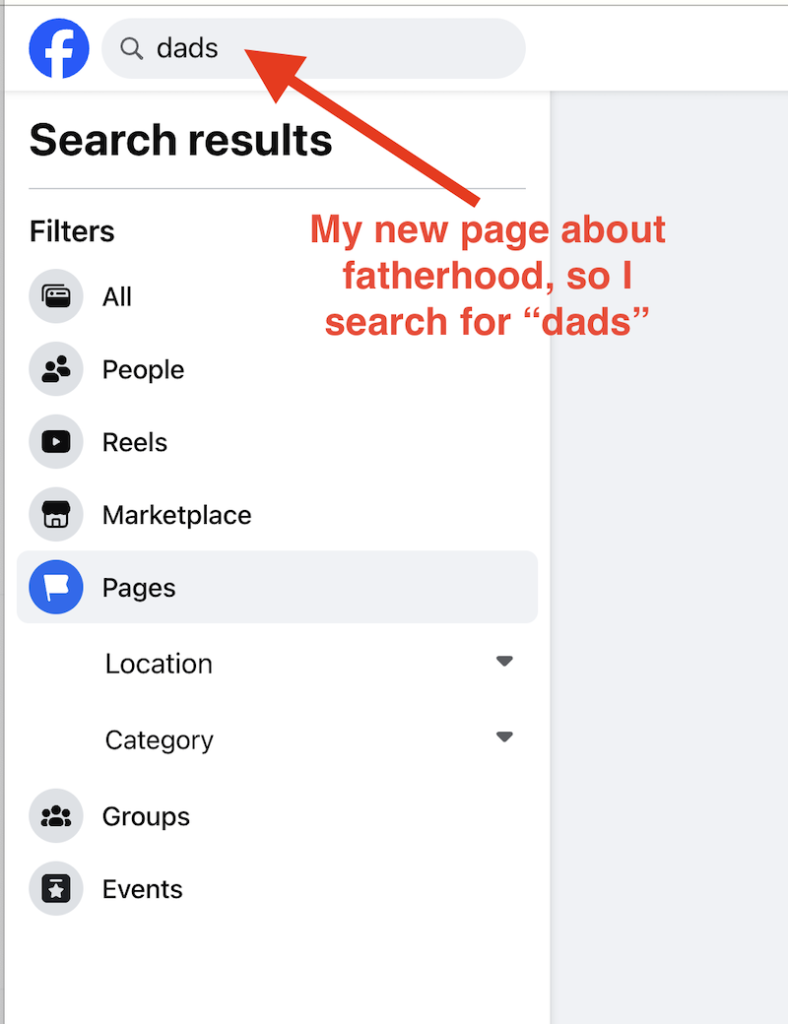
I check all the pages showing up in the results. I start clicking on the most relevant ones, the more relevant, the better. It could be pages, posts, or groups. I click on all of those results to see if they’re what I’m looking for.
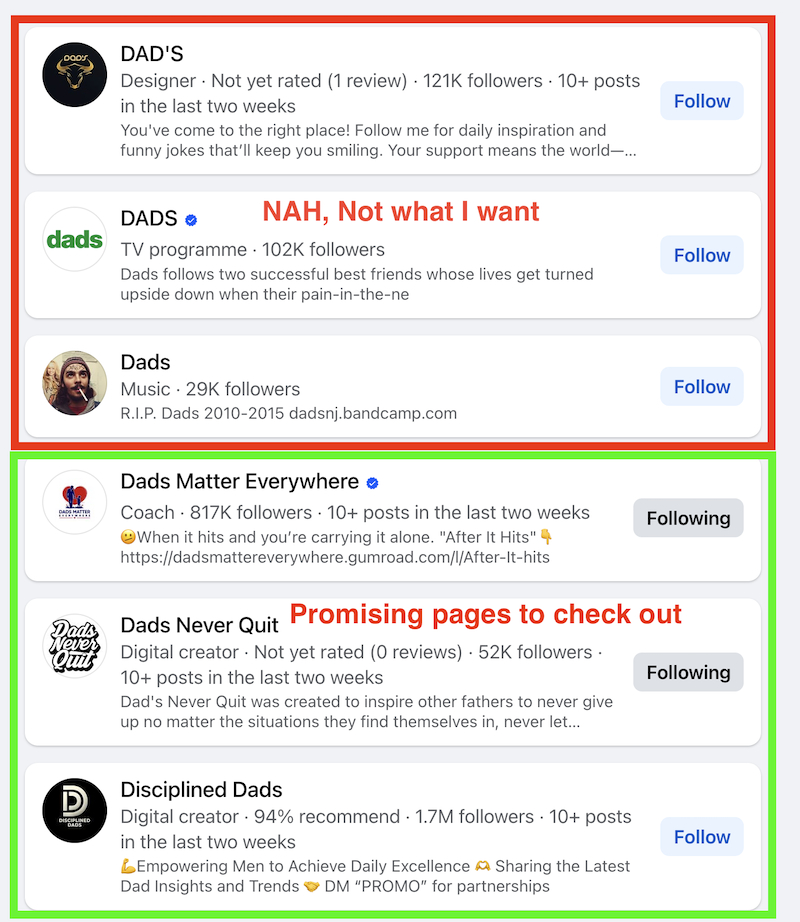
What I’m looking for is relevant posts in my niche, the more viral, the better.
Then I hit the like button on the most relevant (& viral) posts, follow those pages (aka competitors), and join those groups.
I even go to the pages behind those viral posts to check for more content from them. If I see posts that are viral and relevant, I hit the like buttons.
I repeat this for all pages and groups I found. I go deep. I look for posts with a few thousand likes, shares, or comments. I like them all. I comment if needed.
You may ask WHY.
It’s simple.
I want Facebook to know exactly what content I’m interested in.
I let the algorithm learn from what I’ve interacted with.
And then…
The social platform magic happens.
Facebook starts recommending me more viral and relevant content (posts, creatives, reels) in the niche of my newly created page.
Now when I check the home feed of my newly created page, I’ll see more viral posts from competitors. Then I rinse and repeat. Like, follow, comment on new viral posts Facebook show me, just like a real user.
This usually takes me about one hour to find the competitors I want, anywhere from 10 to 50 pages, sometimes even more.
And the beauty of this method? Your page’s home feed becomes a live dashboard of up-to-date, viral content in your niche.
Now it’s time to reverse engineer.
I look at the kinds of posts that are doing well. You’ll usually see patterns, either status posts, TOBI posts, image posts, or reels (videos), etc.
Whatever format is working, you might want to test that same format on your new page.
DON’T COPY POSTS.
That invites unwanted reports and might get your page banned.
Instead, learn from those viral posts. Get used to the content style. Then ask GPT to generate similar ideas for you, up to 20 ideas. Pick one or two of the best, schedule them, and check the results the next day.
Did I tell you to grow followers with Facebook ads yet?
If not, then yeah, you might want to do that. It makes your life much easier when you have a few thousand real followers (real humans, not bots).
Those first few thousand followers are extremely important.
But that’s a whole different article.
Just remember, they matter. Very much.
FAQs
1. Why do I need a brand new page? Can’t I use my personal account?
You might not want to use your personal account for a few reasons.
First, your personal account is already personalized around your own interests. That limits the number of niche viral posts Facebook can show you. Remember, we want as many viral posts in our new page’s niche as possible.
Second, personally, I don’t want to mess up my personal feed with niche content that’s purely business-related. I just don’t want to see those posts after work.
Third, imagine you have more than one niche, maybe five. That’s way too much for one personal account.
I’m not saying it’s impossible to use your personal account. It’s just not as effective as creating a brand new page and making it super focused on one niche.
2. Should this new page have posts on it already or stay empty?
Your new page can stay empty while you’re searching for competitor pages. It won’t affect your search.
3. Should I optimize the page (bio, profile pic, niche keywords) first?
You can fill in the bio and profile pic if you want, but it’s not a must. Leaving it blank won’t hurt while you’re searching for competitors.
4. Does Facebook treat a brand-new page differently?
A brand new page has zero data for the Facebook algorithm to learn from.
So while you’re searching and interacting with viral posts in the niche, you’re basically teaching Facebook what you like and what you want more of.
This method trains the algorithm on purpose, leading you to more competitor pages and viral content. That’s the beauty of it.
5. Will liking too many posts from a new page look suspicious?
It can be (I think).
But since you’re doing it manually, I don’t think it looks suspicious. As a human (are you? 😄), you can’t like 1,000 posts in 5 minutes like bots do.
So I’d say it’s generally safe.
While we’re on this topic, I highly recommend limiting automation tools when managing Facebook pages. Facebook doesn’t like aggressive automation and can punish your pages.
6. What keywords should I search exactly?
Use common sense.
For example, if I create a page in the fatherhood niche, I’d search keywords like:
“father”, “dad”, “my daughter”, “my son”, etc.
You can ask GPT to help generate more related keywords. It shouldn’t be hard.
7. Should I search broad keywords or very specific ones?
Try both.
Any keyword that clearly teaches the algorithm what you’re looking for will work best. Avoid misleading or unrelated keywords, or the algorithm might show you the wrong posts and pages.
8. What if my niche is too competitive? What if my niche is too small?
If the niche is too competitive, you’ll see a lot of pages and posts doing well. That’s good and bad at the same time.
- Good because you have many model pages and post types to learn from.
- Bad because you’ll need to compete with them.
I believe there’s room for everyone but I might be wrong. So test it yourself.
If your niche is too small, you might find very few pages or posts. That can be both a risk and an opportunity.
- The risk: maybe the niche simply doesn’t work on Facebook.
- The opportunity: it could still work, but you’ll need to DIY your winning posts. It’s harder but very possible.
9. How do I know if a page is truly a competitor?
This sounds crazy, but you’ll know it when you see it. Trust your instinct.
10. Should I look at global pages or only pages in my country?
I target a US audience, so I look for English pages with the US users. You should align this with the audience you want to reach.
11. How many likes count as “viral”?
For me, anything with more than 1,000 likes is worth looking at.
10K or 100K likes? Even better, of course.
12. What’s more important: likes, comments, or shares?
From my experience, the order is:
Likes > Shares > Comments.
13. Should I care more about reels or image posts?
Each niche has different viral formats.
- Some niches go viral with TOBI (Text On Background Image).
- Some with image posts.
- Some with reels.
Care about whatever format works best in your niche.
14. What if posts are viral but the page itself is small?
That’s even better.
If a small page creates super viral posts, those posts are powerful and worth learning from.
15. How do I know if engagement is real or fake?
I rarely see fake engagement pages that last long, but they do exist.
- Check if the page posts consistently, day after day.
- Check if they have multiple viral posts, not just one lucky hit.
Solid pages usually have several viral posts per week.
Don’t overcomplicate it. Facebook is getting better at cracking down on fake pages. If a page looks solid, it’s probably the real deal.
16. How long does it take for the algorithm to adjust?
Usually very fast.
After you like viral posts and follow strong pages in your niche, check your page’s home feed. You should start seeing more relevant viral posts almost immediately.
17. Do I need to interact daily?
You can, but it’s optional.
The more you interact with relevant viral posts, the better the algorithm understands your niche.
18. Should I copy the posting frequency?
I don’t recommend copying posting frequency.
Established big pages can post 30–50 times a day. A new page shouldn’t.
If you’re small, 2-5 high-quality posts per day is more than enough.
Make sure every post is as good as you can make it. Too many low-performing posts can slowly kill a page.
How I schedule and analyze our Facebook posts
I used to pay for two tools: one to schedule posts and another to see what actually worked. It was expensive, messy, and neither was really built for Facebook pages. So I built my tool that does both, properly, in one place: Insight Hive.
Facebook Pages, Groups: How to Earn Money By Posting Images, Reels or Stories - Insight Hive Blog
Thursday 8th of October 2026
[…] The best approach is always test different formats and double down on what works. […]
GaryDbz
Sunday 1st of March 2026
super useful post in a niche i'm aquainted with. you should write more of these!
Van
Tuesday 3rd of March 2026
Thanks for the feedback, Gary! I’m working on more posts about driving traffic from Facebook, stay tuned.